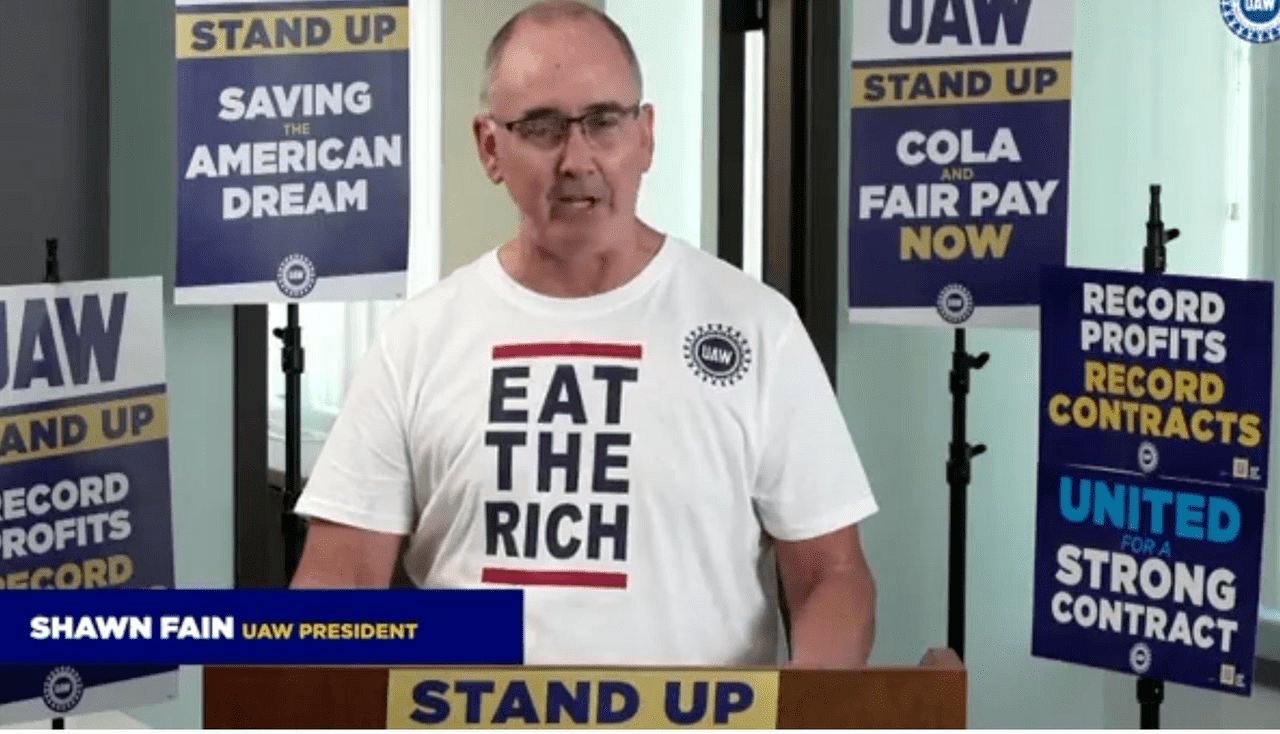
CNN’s John Blake, in an article that you should read, calls attention to how UAW president Shawn Fain drew upon his Christian faith, and on words of Jesus in the Gospel of Matthew, to fortify the courage of auto workers headed into the recently concluded strike. It’s a good article.
For friends who know where I work, I would like to point out that two of the people Blake cites are Eerdmans authors.
Liz Theoharis, a close colleague of William Barber II, is author of Always with Us? What Jesus Really Said about the Poor in the Prophetic Christianity series. This book debunks the use of one New Testament verse, that has soften been taken out of context and used as a basis for excusing Christians for caring for the poor. More importantly, it demonstrates the opposite: that neglecting the poor is not a Christian option.
And in writing his CNN piece Blake credits an earlier and longer article by Heath Carter, who serves Eerdmans as one of the editors of the Library of Religious Biography and as editor-at-large for history. You should read Heath’s article as well. He traces the connection of the labor movement with the Christian gospel through the decades.
I would like to register just one little caveat. Historians of Christianity do indeed use the phrase “social gospel” to label the teaching of theologians and pastors who have recognized that being a follower of Jesus means being obligated to care for the poor.
It’s a useful label. But Christians who wish to deny that obligation turn the label into a denunciation, speaking as though the social gospel were another gospel, a new gospel, that must be rejected in favor of the true gospel of salvation through faith in Christ’s death and resurrection.
But the true gospel does not separate faith in Christ from obedience to and imitation of Jesus. The innovation and falsification is not the recognition of Jesus’s concern for the poor; the innovation is the move in later-twentieth-century evangelicalism to abandon obedience to Jesus in the matter of caring for the poor.
Shawn Fain was right:
In the Kingdom of God no one hoards all the wealth while everybody else suffers and starves. In the Kingdom of God no one puts themselves in a position of total domination over the entire community.
The “social gospel” is not a substitute for faith in Jesus. But it is a test for showing whether professed faith in Jesus is authentic or empty.

 Verba Sparsa
Thank you for this, James. I appreciate the perspective check. The Blake article was very instructive.
LikeLike