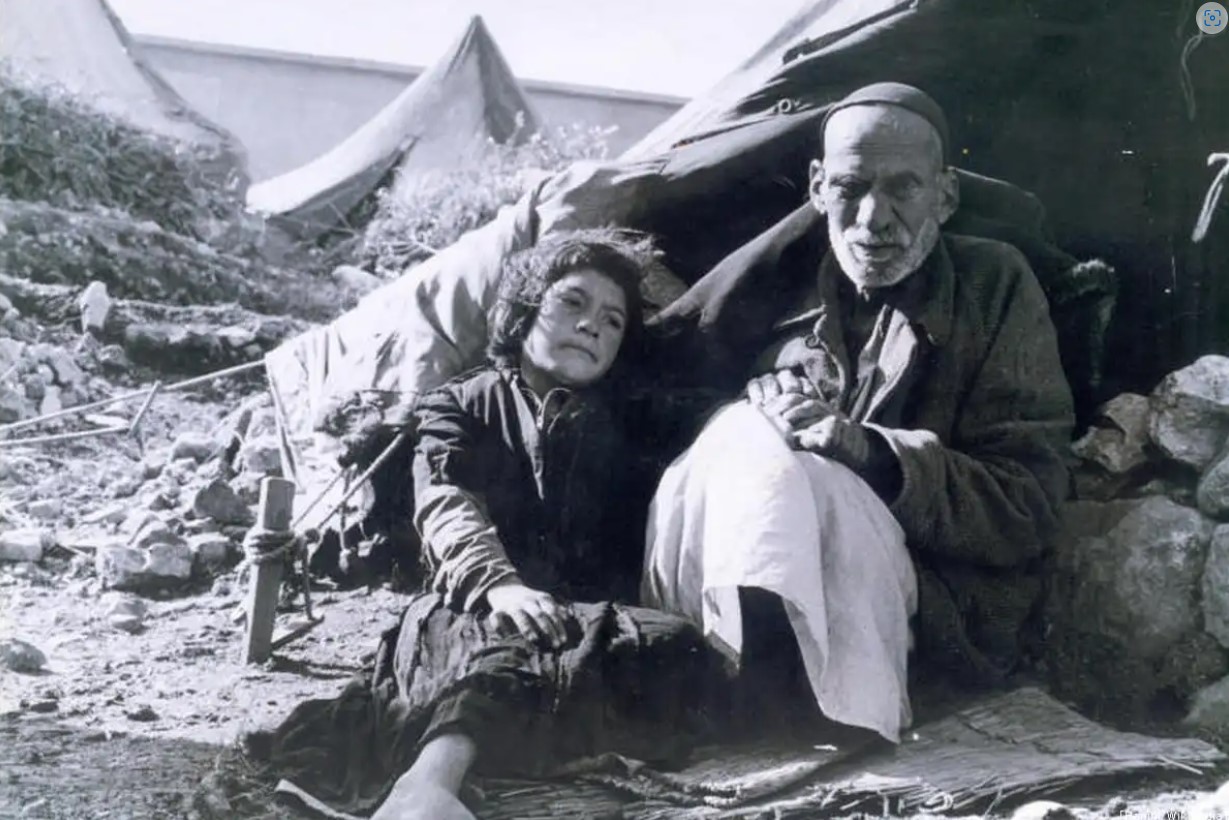
Some realizations dawn slowly.
Let’s say you believe that sometime around 1200 years before Christ, the God YHWH, who made promises to Abraham and gave the Torah to Moses, commanded the Israelites to take Canaanite towns by force, slaughtering men, women, children, and livestock. How much difficulty would you then have believing also that in 1948 CE the Master of the Universe would authorize Jewish refugee-colonists, claiming to be the heirs of biblical Abraham, to evict 750,000 Palestinian people from their homes and their villages forcibly, taking over those homes and that land for themselves?
And believing those things, why would you not also believe that the resultant State of Israel has the right to construct an apartheid regime, and take more and more land not originally authorized?
And then, if a militant faction of the dispossessed and displaced Palestinians “living” in forced isolation and deprivation in Gaza, the most densely populated little territory in the world, were in 2023 to launch a murderous attack on Israeli colonist-settlers, why would you have any difficulty believing this State of Israel to be fully justified in responding with a genocidal campaign of obliteration in Gaza?
I mean, you already, in the very first step, made clear what you believe about the moral character of the Master of the Universe. You believe that if the moral arc of the universe is long, it bends toward favoring one people and rejecting another, and licensing the former to kill and dispossess the latter. You already believe that the moral arc of the universe bends toward genocide.
Around 1984, when I was an MDiv student at Gordon Conwell-Theological Seminary, the required social ethics course was taught, in the absence of Stephen Mott, by Eldin Villafañe, who was completing his PhD at Boston University. His dissertation supervisor was Prof. Paul Deats, the first Walter G. Muelder Professor of Social Ethics at BU. He invited Prof. Deats to give a guest lecture on the ethics of war and peace.
During his discussion of jus in bello, he would of course note that in just-war theory not everything is permitted. For example, one must avoid, as far as possible, killing noncombatants, which means that indiscriminate bombing of areas with civilian populations is not permitted. A student asked: but Professor Deats, after the Exodus, didn’t God command the Israelites to slaughter Canaanite men, women, and children?
Deats was a calm and gentle man. But at that question, his countenance darkened, and he pounded his hands on the lectern and said: The God I worship never commanded anyone to slaughter men, women, and children! Stunned silence throughout the large lecture hall. I think my eyes must have been very large. Gordon-Conwell faculty and students were inerrantists. Did Prof. Deats worship some god other than the God of the Bible? I looked to where Prof. Villafañe was sitting. Did he knowingly invite a theological liberal to teach a class at Gordon-Conwell? Villafañe was sitting very still.
As you can see, I never forgot that moment.
After the Holocaust, Christians with any moral sensibility were forced—I should say, have been forced, since the project is ongoing and incomplete—to rethink their theology. We have been forced to rethink our theology because the realization dawned that our Lord and Savior Jesus Christ stands for something very different from racial hatred, ideological distortions of history, and genocide, and that nevertheless somehow Christianity, though claiming allegiance to Christ, was largely responsible for as outrageous a moral atrocity as the world had ever seen.
Christians, used to basing their dogmatic formulations on scripture, tradition, and reason, suddenly realized that their formulations must be rethought in light of two other sources of insight, two very large things that they could not ignore: the Holocaust, and the character of Jesus Christ.
I wonder whether we are approaching a moment when it will dawn upon large numbers of Christians that we now also in our day are face to face with two realities that do not align well: Christian support for the Nakba, and the character of our Lord and Savior Jesus Christ.
Christians will not abandon Scripture. It is a given. But . . .
After his resurrection, our Lord appeared to two of his disciples on the road to Emmaus and opened the Scriptures to them, explaining how all of it applied to himself. He did not annul Scripture. He interpreted it. The Berean believers were praised not for abandoning the Jewish scriptures but for searching them and finding Jesus Christ in them. (To be clear, most previous readers of most of those scriptures had never seen Jesus Christ in them, and many still do not.)
When my wife and I lived in Manchester NH several decades ago, an ecumenically minded rabbi used to attend worship on Christmas and Easter at the Congregational church where my wife served. After one of those services I said something to him about the clear anti-Semitic undertones in one of the New Testament passages that was read. He said: Ah. Yes. But you cannot reject that passage. It is part of your scripture. The task is interpretation. You must interpret.
An observation regarding interpretation: it matters where you’re standing when you look at something. Interpretation, for beings who are not omnipresent and omniscient, is always affected by perspective, by angle of vision. Let’s say there is a truth that is not relative. Fine. Still, a finite being has no way non-relative way of approaching that truth. Where we are standing affects what we are able to see.
I have just finished reading a book by an evangelical pastor named Munther Isaac. Dr. Isaac is the pastor of a Lutheran church in Bethlehem, in Palestine. Perhaps you saw a photograph of the creche in that church. Many photos are on the Internet. One of the best I have seen is Heidi Levine’s for the Washington Post, which I include here.
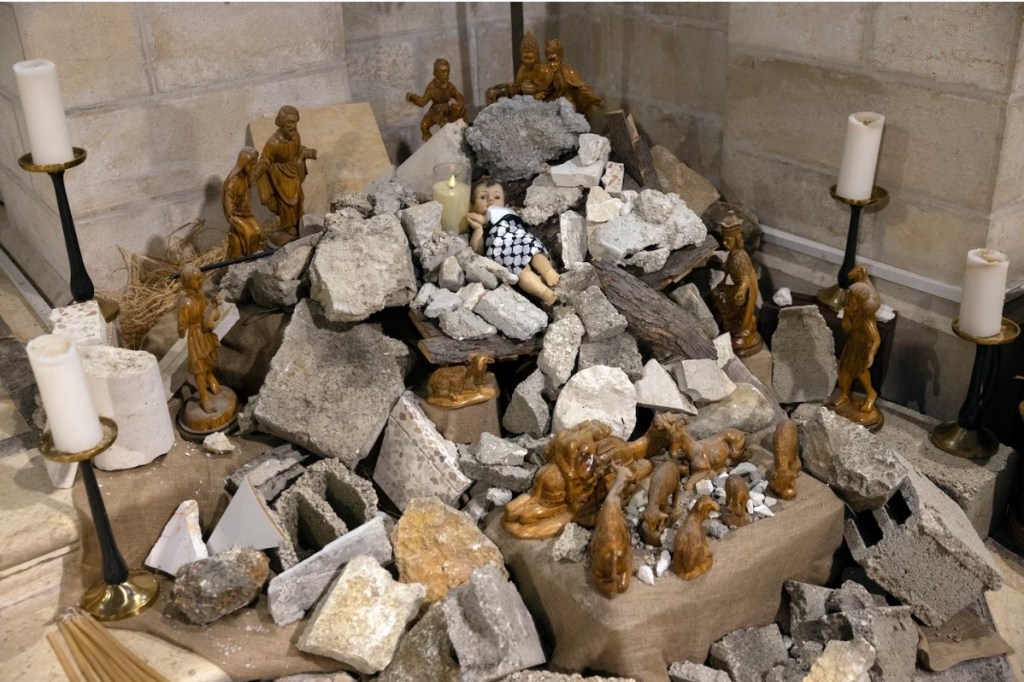
So that is where Munther Isaac stands, and sits, and sleeps: in the town where Christians believe Jesus was born. It is a Palestinian town, a West Bank town, a town under Israeli military control. Around Christmas, I watched via video-link a service of lament at his church. (You can still watch it, on YouTube: https://www.youtube.com/watch?v=juCkshyqGN8.) I was so impressed by his sermon that I wondered whether he has written a book. (Well, I make my living publishing books, so. . . .) And I found that he has: The Other Side of the Wall: A Palestinian Christian Narrative of Lament and Hope. I recommend it highly for Christians open to considering how the application of biblical promises and prophecies to the modern State of Israel looks to Christians who are “on the other side of the wall.”
Anyone who has ever read the whole Hebrew Bible, or delved into rabbinic texts, knows the richness and complexity of Jewish hermeneutical tradition. The Jewish tradition knows how to interpret. Interpretation is not making the text mean whatever you want it to mean, but it is also not assuming that the divine meaning in a text is simply whatever you get from the plain, obvious sense of the words. It is wrestling with the text, as Jacob wrestled with the Angel of God, until God relents and gives you a blessing. God may also give you a permanent wound in the process.
Now, as the Nakba runs its course and reveals its inner meaning, which is genocide, what blessing will Jewish and Christian interpreters of Scripture seek? And what wound will they accept as a sign of the reality of their encounter with the living God?
 Verba Sparsa
One thought on “Nakba as source of theological insight?”