Summary
The essay that follows comprises nearly nine thousand words. It is long because it says some things that had to be said carefully and with adequate support. So I begin with a summary. If the summary interests you, I invite you to read the whole for detail.
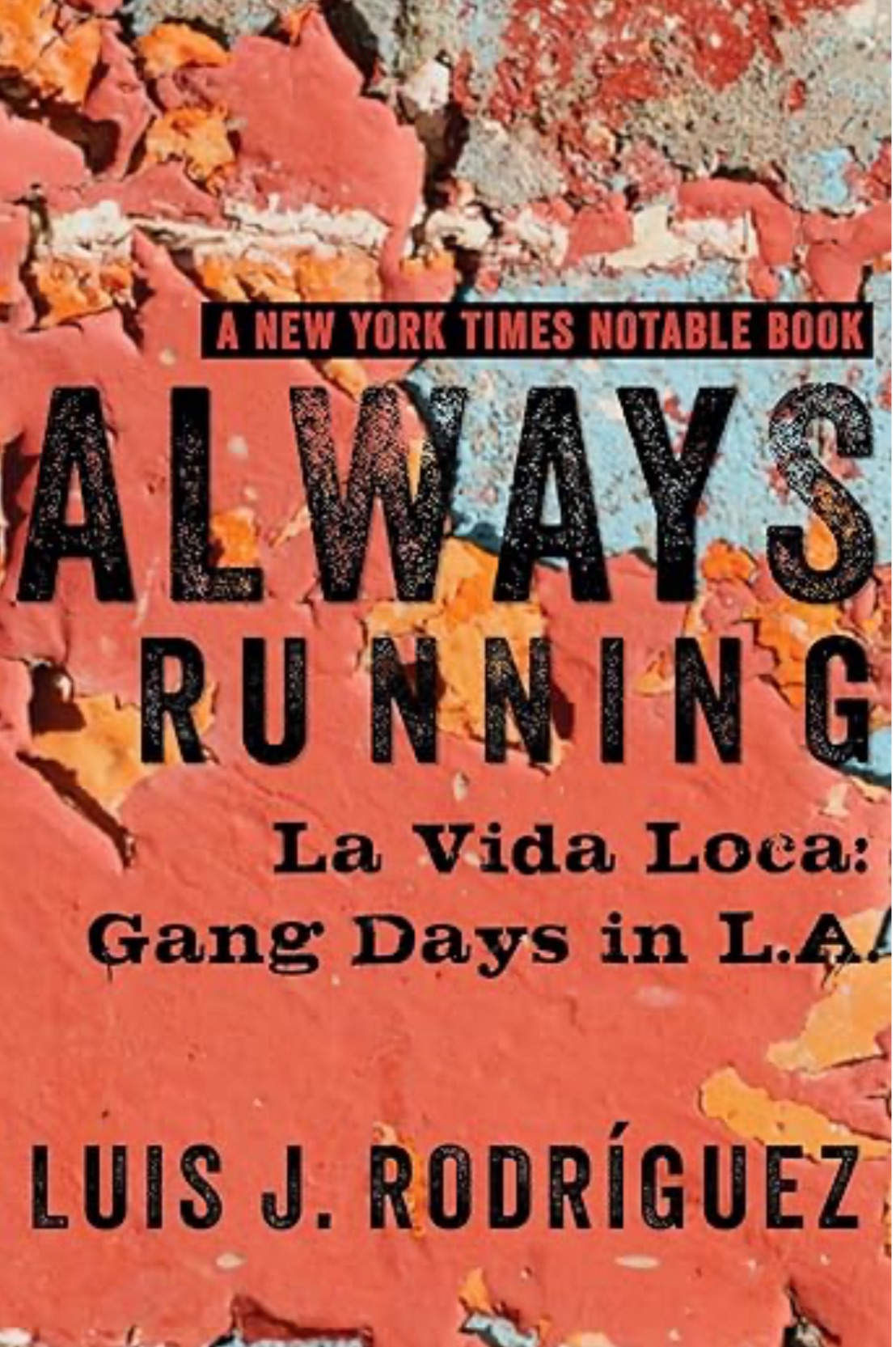
At the September 16 Caledonia school board meeting, State Representative Angela Rigas read aloud a sexually explicit passage from a book titled Always Running. The reason she gave for doing so is questionable. Her representation of the content of the book as a whole was false, and gave no evidence of deep thought about the purposes and functions of books in education.
Rather, it seems that her reading was a performance aimed at stirring up negative emotions to motivate Caledonians to reelect her to the state legislature and elect her allies to seats on the school board, thus securing a majority of seats for people who could try to micromanage curriculum and resources. The ultimate aim is to either make the schools propagate rightwing political ideology or divert public funding from the public schools to private, religious, or commercial alternatives.
In order to do that, Rigas sets herself up as the lead spokesperson for conservative Christian sexual morality. The truthfulness of that self-presentation, however, is problematic. Political allies of Rigas’s have publicly aired accounts of her personal life that contradict her claim to stand for traditional Christian morality. Citizens who want to understand her aims and motives need to pay attention to these accounts and decide whether they are being misled.
The population of the Caledonia school district is largely Christian and largely conservative. The content and character of instruction in our schools is therefore (perhaps appropriately) more conservative than liberal. Caledonia schools are very far from being hotbeds of liberalism. That is not a problem that we have in Caledonia. It is a fictional problem created by Rigas and her allies in an attempt to manipulate sincerely conservative Christian people into supporting a partisan ideological takeover of our schools that will not benefit our students. Angela’s speech at the September 16 meeting was another moment—an important revelatory moment, for those with eyes to see—in that ongoing attempt.
We do not need a takeover of our schools by people who are unqualified to oversee a large school system and are under the influence of national political organizations. We must not allow anyone to use duplicity and disinformation to accomplish such a takeover. What we need in our legislature and on our school board is integrity.
In the September 16 meeting of the board of trustees of the Caledonia Community Schools, State Representative Angela Rigas took the podium during public-comment time and said things that had to be muted in the official recording.
This was not Angela Rigas’s first dramatic appearance at a Caledonia school board meeting. I posted my description of her words at the May 16, 2022, meeting in a blog post that is still available for any who are interested.
This time Angela’s speech was more explosive, and the issues that it raises are more complex, so this post will be longer.
What Angela Rigas said at the 9/16/2024 school board meeting
Caledonia school board meetings are video-recorded, and the district office posts the recordings to a YouTube channel called CCS Board of Education Recordings. The September meeting is posted here. I was not able to attend, so I have had to rely on the video. Perhaps you will want to watch the video as well. But I have transcribed Angela’s comments.
During the public comment time, 11:25 into the meeting, a warning covers the screen:
Content Advisory. The following portion of the recording contains explicit language or content that may not be suitable for children. Viewer discretion is advised. This section will last approximately 3 minutes.
After the warning message is lifted, you see Angela Rigas walk to the podium. A parent stands up and leaves the room with a child. Angela begins to speak:
Hi. Thank you. So last week my son approached me—he’s a freshman—with some concerns he had about a book he was reading. It was a free-choice book. And he said that—he voiced his opinion that the book was too violent. It was far too violent. He wasn’t comfortable reading it. So I looked through the book, like any parent would, to see what their child was reading at school. And what I found in the book was actually far more worrisome than violence. The book is called Always Running.
At this point, Angela turned around to glance quickly at the audience, then turned back to the front of the room.
And now that we don’t have any small ears in here, I would like to share a paragraph that I found to be absolutely disgusting.
Angela had seen no young children when she glanced around, but I am told that a young woman—a high-school student who spoke during the meeting as a student representative—was still in the room. At this point, the following message appears on the screen: “Audio muted due to non-compliance with Caledonia Community Schools online content standards.” So the video is silent from 12:42 to 13:37. Someone who was present at the meeting told me I could find the paragraph in question by searching for a term for female genitalia. I found the passage. It contains an explicit description, including the names of the body parts involved, of sexual activity between the teenage narrator of the story and a teenage girlfriend.
When the sound is turned back on, we hear Angela saying:
And that’s why I’m shaking, because I don’t like talking—I don’t like reading this sort of thing in public, but this book, Always Running, it glorifies gun violence, it glorifies gang activity, it glorifies suicide, drug use, prostitution, it mentions abortion, and—like you just read—that was just one of three excerpts from that book. My son is fourteen! Fourteen years old. I reached out to some of your board members; I had very pleasant conversations. I reached out to the superintendent and also to the principal of Caledonia High School. And I’m actually here to praise you on the responses, and on your concern, and your willingness to address this issue that we have in our school. I thank you for listening to me as a parent.
And if I could add one more thing—I know I’m out of time and I’m sorry, but—the issue with my son has been handled, the book is no longer in his hands, but now he’s having conversation with his classmates. A young man approached him and said, “I’m too embarrassed to read this book, but I’m almost even more embarrassed to share it with my parents, because I feel like I did something wrong by reading this book.”
And the book was given back to the teacher. I called the teacher, and we had a conversation. The conversation went like, um, we must create a safe environment for all students to thrive—and I realize I’m almost nearing my time—but if we really wanted to create a “safe environment” for the students in Caledonia, we should not be giving them materials that glorify gun violence, drug use, prostitution, and such. The world out there is already bad enough, and we don’t need to put these thoughts and images in these young and impressionable minds.
“This book” is about a young woman who is inexperienced, with an older man who has much sexual experience, because she’s afraid to say no, or whatever the case may be, she decides to just lay down and take it. And this child does not feel comfortable talking with his parent.
(Angela is no longer describing Always Running. Here she is talking about a second book whose title she does not give.)
My child did, and that’s why I’m here to [speak] today [I supplied the word “speak”; the recording glitches at this point]. So I understand that there’s conversations being held to change policy; there is no policy in place that free-choice reading has to be vetted and approved by the board, so I encourage a policy change, to make sure that our students are only receiving age-appropriate materials. Thank you. And I’m sorry that I had to read that to you; it’s embarrassing. Thank you for your time. I appreciate you very much.
There’s a lot to unpack here, and I will unpack it at some length, but I want to begin by expressing several points of agreement with Angela and affirming some things I think she was implying.
- The passage that Angela read aloud from Always Running is indeed sexually explicit, and it is not in my opinion appropriate reading for sexually inexperienced high-school students.
- The book does contain the sorts of violence that Angela mentioned, and others that she did not mention. Such violence should be disturbing not only to high-school students but to anyone.
- The book also describes drug use and prostitution. It mentions abortion only as an option that a young man suggested to his sexual partner and she rejected. Again, this content could be disturbing to high-school students and others.
- I do not approve of the sexual conduct, the violence, or the drug use described in this book, and I think most Caledonia parents would not approve. The sort of life described in this book is not a lifestyle that any of us would want to recommend to our children.
What are books for?
At this point I want to step back from what Angela said, and from the books she was talking about, to ask some general questions: What are books for? How are books meant to affect readers, and how do they affect readers? According to what principles should we decide what we will read, and what we will let our children read?
Books can have many purposes, but I want to suggest a few basic possibilities.
Ancient thinkers suggested that rhetoric (speech deliberately arranged to serve a purpose) could be for profit (benefitting the reader in some way) or for delight (entertaining the reader).
I suggest that in schools, books should be for profit, not for delight. Let me add quickly that the aesthetic and intellectual pleasure that readers can derive from stories, plays, and poems is good. But in schools, there should always be profit in the form of an educational benefit. In the earlier grades, and to some extent in later grades, the benefit can be simply learning how to read. It can be good to provide books that are merely entertaining as an incentive for learning to read. But beyond the teaching of the skill of reading, books can profit students by forming their minds and equipping them for life.
Some possible reading experiences should be avoided, even banned, in schools. For example, motivating students to read by providing stories that use sex or violence to titillate and entertain would run counter to the aims of education. That’s pretty much the definition of pornography: describing sex acts graphically for the sake of titillation. Pornography has no place in education. Writings that simply glorify or glamorize vice, violence, and crime have no place in education. Such books exist. But such books yield no profit, only loss: loss of virtue, corruption of character.
Under the heading of “profit,” I would like to suggest that one way a story can function is to provide a model for imitation. Another way a story can function is to help readers understand reality. This could mean helping readers understand realities they have experienced but have not yet understood; or it could mean helping readers understand realities they may experience later; or it could mean helping readers understand others’ experiences precisely in order to help them avoid ever experiencing them themselves.
So books used in schools can cover a spectrum: from books that provide innocent enjoyment, to books that provide positive models for imitation, to books that warn of the darknesses and pitfalls of life in the world. The point of this latter sort of book is to help readers cope with negativities and move beyond them to better things. Many books do all three of these things, so these aims are not mutually exclusive. But books may do more of one and less of others. My general suggestion is that as children progress from grade 1 to grade 12, we should start them with innocent enjoyment, advance into positive instruction (including providing inspiring models for imitation), and progress further during the high school years to books in which they can find acknowledgment and exposition of the darkness that by that age they will know exists in the world.
We cannot afford to think of high school students as holy innocents who have never been, and must never be, exposed to anything unsavory. By the time students turn eighteen, they will be eligible for military service, and they will be able to vote. Many will have experienced depression and anxiety. A high percentage of them, I am sorry to say, will have experienced sexual intercourse (you can find the statistics as easily as I can; they are sobering). Even higher percentages of them will have encountered pornography on the Internet, some of it quite hardcore. Some will have become addicted to it. Every student will have seen or heard news reports of all kinds of violence and destruction.
A first grader is innocent in so many ways. It is normal and good to try to protect and extend the innocence of childhood. But parents who think their children are as innocent in ninth, tenth, eleventh, and twelfth grade as they were in elementary school are deceiving themselves. Parents who think the mission of a high school should be to preserve naïveté are missing the point: education for adulthood includes being forewarned of adult problems, and thus forearmed to cope with them. Our young people will most certainly see the darkness in the world, and, despite our best efforts, they may contribute to it or suffer from it. The question is: can they count on us—parents, teachers, and other adults in their lives—to help them prepare for it and process it? Or will they find us covering our eyes and ears, pretending that it isn’t there, perhaps even participating in it while denying it, and expecting them to do the same? And when the darkness—including our own personal darkness—cannot be hidden, claiming, like Captain Renault in Casablanca, to be “shocked! shocked!”
Should we ban books that depict bad morality in action?
Is it legitimate to try to keep all depictions of immorality in action out of books that we make available to high schoolers? You can already guess my answer by now: no.
But let me discuss just a few cases. What about Homer’s Iliad, one of the great foundational classics of Western literature? It has been years since I read it, but I remember much of it well, because it is a powerful story. Does it provide innocent entertainment? Maybe in places, but in general, no. Could we fairly say that the Iliad glorifies violence? At least in this or that passage here and there, it does: heroes triumph gloriously over their foes. And these glorious triumphs can be ugly and shocking. It would be easy for anyone to pull excerpts from the Iliad and argue that it should be banned. Achilles, the hero, is so enraged by the killing in battle of his friend (or lover) Patroclus that after killing Paris, who had killed Patroclus, Achilles drags the body of Paris around Troy for many days.
Many killings in the Iliad are described in graphic language. So, again, would it be fair to say that the Iliad glorifies war and violence? In the final analysis, taking in the Iliad as a whole, the intelligent answer is a resounding no! You may have to read the whole thing to know that, but if you have read the whole thing and don’t understand by the end that the message of the Iliad is powerfully anti-war, you haven’t read well. You might need a teacher to help you read well. You might suffer some distress along the way to getting to that conclusion. But should your mom jump in to protect you from having to learn to read a complex work of literature with depth of understanding? I would say: that depends on how old you are and what your capacity is for learning. For most emotionally and mentally healthy high school students, the answer should be no.
(To be clear though: in Caledonia and throughout Michigan, a parent has the right to intervene to get their child exempted from any assignment they believe the child can’t handle. That is already a parental right, and as far as I know, no one is trying to change it. It is an uncontested non-issue. No school board member can secure that right for you, because you already have it, nor can any school board member take it away; it is not in their power to override state law on that point.)
Take another foundational classic in the Western literary tradition (though it is not originally a Western book): the Bible. Everyone who has read the Bible knows that it contains much sex and violence. In the Song of Songs (also known as the Song of Solomon), the erotic language is veiled and tame compared to what we routinely see in modern books, but for many centuries it was regarded as dangerously provocative. Some Jewish traditions advised against letting young men read the Song of Songs before they were eighteen. Or consider the story of the Levite’s concubine in Judges 19–21. Is there a more horrible story anywhere in world literature? And I could tell you about so many other horrible stories and passages in the Bible. Decades ago, when I was getting my education in biblical studies, one of the leading books in Old Testament studies was titled Texts of Terror—and for good reason.
So should the Bible be banned from schools because it glorifies sex and violence? No, that would reflect a failure to understand how these parts of the Bible function in relation to the whole. Now, you might need a good teacher to help you discern how it all fits together. And a good teacher will know which parts to avoid assigning to which students in order to avoid doing more harm than good. But simply banning the Bible, like simply banning the Iliad, would be an unintelligent and anti-educational move.
I can think of so many books that I read in high school that had deplorable content. The conditions under which children suffer in Dickens’s novels are awful. So also with Theodore Dreiser’s American Tragedy and Stephen Crane’s Maggie: Girl of the Streets. Mark Twain’s books convey, arguably, an anti-racist message while depicting a thoroughly racist society. I remember Hemingway’s description of the stillborn child of an unmarried protagonist: looked like a freshly skinned rabbit, he said. (Was this “glorifying abortion”? A stillbirth is, medically speaking, an abortion. But that question would strike anyone who has read A Farewell to Arms as stunningly obtuse.) You could run through the entire corpus of all serious literature from all centuries and all continents making similar observations.
So what about Always Running?
When I heard Angela’s comments about Always Running, I bought the book and read it. It was not easy to get into, not my kind of story. But I persevered, and I learned some things. The world of Chicano gangs in the Los Angeles area in the 1960s and 1970s is far removed from my own experience of growing up in central Virginia in the 1960s and 1970s. The life story of Luis J. Rodriguez is quite different from my own.
But as I read, I admired his ability as a writer. Passages of lyrical beauty are not rare. Far more frequent, I grant you, are descriptions of appallingly bad choices—but an honest reader recognizes quickly that these choices are made by a protagonist who has been given a very limited range of options. My teenage life was not so much cleaner than Rodriguez’s because I am inherently more virtuous. My life was better because I was given so much more. Can I read his book and imaginatively—and empathetically—grasp the conditions under which he had to live?
Rodriguez narrates what he saw and what he did with astonishing objectivity. For the most part, he neither blames nor praises his own actions or the actions of others around him. He tells what they did. He tells what he did. He makes no excuses. Not for the violence, not for the drugs, not for the sex.
And he does not “glorify” any of it.
When I paused to ask myself what else I had ever read that resembled this book in its no-excuses, nothing-hidden, nothing-denied honesty, I surprised myself by answering: The Confessions of St. Augustine. A literature teacher could tell you that the Confessions is another of the foundational works of Western literature. Others before Augustine had written about their own lives. But never with such openness, such honesty, and with such a deliberately sustained effort to look to something higher, and point readers to something higher. Augustine confesses his theft of pears from a neighbor’s tree when he was a child—not to tell a cute story, but to reveal how the power of sin gripped him even from an early age. And he quite openly confesses his devotion to fornication throughout his young adult years, describing at great length the slow conversion process that eventually liberated him and turned him to God.
So here is another thing Luis Rodriguez and St. Augustine have in common: neither of them concealed or denied their own sexual immorality, pretending to be innocent models of sexual righteousness while pointing an accusing and condemning finger at others. They both wrote book-length confessions. Yes, that is the genre. That is what Always Running is. It is a secular, twentieth-century Confessions. The Confessions of St. Augustine is a more powerful book, and has endured for a millennium and a half, because his conversion was more complete. But the confessions of Luis Rodriguez, just as rigorous in truth-telling though not anointed with theological completeness and clarity, are also powerful.
As Jesus said: “The truth will make you free.” Total embrace of the divine and human truth brings complete freedom. Partial apprehension of human truth brings partial liberation. Concealment and denial of truth brings bondage—for oneself and for others whom one dominates. Augustine and Rodriguez both knew this. We could all learn something from them. Denying the truth about one’s own adulteries or murders, for example, while professing to be shocked by the sexual sins and violent crimes of others, or while condemning or demeaning others for their sins, or, worse yet, for their non-sinful struggles to come to terms with their own sexual and gender identity—may ultimately be as dangerous to one’s own soul, and to one’s community, as joining a gang or committing murder. What is murder but the hateful negation of a human person?
Theology and politics in Augustine, Rodriguez, and Rigas
As noted, the similarity between the two books is incomplete. Augustine’s Confessions address the divine “You” who has saved him. In Always Running, Luis Rodriguez does not address his narrative to God. God is there, occasionally, in the Catholicism of a mother or a grandmother. God is there when Rodriguez reveals that one of his long-time fellow gang members later “accepted Jesus Christ as his personal savior.” Here again, Rodriguez objectively recounts: he neither scorns nor praises this conversion.
As a Christian reader, I see God’s providence in the preservation of Luis from the death that could so easily have taken him and in the salutary effects of his good work over the three decades since he was freed from his bondage to gangs. And as a Christian reader, I cannot help wishing that Luis had found Jesus, or that Jesus had captured Rodriguez, in the course of this story.
But Luis, from early in the book, was at least catching glimpses of something higher and better than the turmoil all around him. The moment comes when he musters the courage to turn down a high-pressure invitation to do drugs—and then is amazed to see that his defiance of that evil inspired seven other teens in that moment to give the same refusal. In the later chapters of the book, Rodriguez narrates how, under the mentorship of a guy called Chente, he learned to withdraw from evil and seek his own good and the good of his community. Chente does not condescend. He does not condemn. He does not use the word “evil.” Nor, as Luis improves himself, does Rodriguez praise himself for his new good works. There is no egoism. No posturing. No God-talk either—but for someone of my convictions, it seems that Luis is being lifted out and up by a higher power.
When Angela says this book “glorifies” gun violence, “glorifies” gang activity, “glorifies” prostitution, she is so utterly wrong that I don’t know how to account for the thoroughness of her wrongness. I do not understand how anyone could read the book and say that. Frankly, I don’t think she read it; I think she took her hatchet-job talking points from the propaganda of some book-banning org. Or if she did read it, she did not understand it. Maybe she needed a teacher to help her read it. It is so clear from the concluding chapters of the book that Rodriguez wrote the story of his own teen years intending to help young readers avoid taking the wretched and tragic course that he took. No one could read the book and miss that.
The author’s prefaces put a sharper point on his purpose: he wanted to save his own son from being sucked into the same life he had lived. The preface to the 1993 edition makes it clear that his son, at age fifteen, was already getting into trouble with Chicagoland Hispanic gangs. And Rodriguez opens the 2005 introduction to the edition that I read by revealing that his son was now in prison, serving a twenty-eight-year sentence for three counts of attempted murder. This is a heart-rending revelation—delivered with no self-pity and with no condemnation of his son. But that same introduction tells how Rodriguez has been an invited speaker in hundreds of public and private schools—including schools here in Michigan, in East Lansing and in Kalamazoo—and in numerous prisons, juvenile detention centers, and rehab centers. Rodriguez and his book do good work.
He then goes on to say:
In spite of this, Always Running has become a lightning rod for certain right-wing groups who are trying to stop its use in school because of the book’s politics and graphic nature. According to the American Library Association, it is one of the 100 most censored book in the United States.
Ah. Politics! Could it be? Rodriguez was saved from gang life in part because he came to realize the craziness of the Vietnam War, and the injustice of the fact that 20 percent of US casualties were Hispanic although Hispanics accounted for only 6 percent of the US population. He became a political activist. From a rightwing perspective, his politics would appear leftwing: he was anti-war, he was in favor of social programs to lift Chicano youths out of addiction and violence by providing them with better outlets for their energy. Might the perceived leftish tilt of Rodriguez’s politics, or racist bias against Latinos, be responsible for the attempts to get the book banned? Might a “shocked! shocked!” response to its “graphic nature” be a convenient pretext for dismissing its cultural-political message?
Toward the end of his introduction Gonzalez writes:
And I thank all the teachers, librarians, parents, students, law enforcement officers, judges, booksellers, writers, rehab counselors and community activists who have ensured my books remain on the shelves, in the hands of young people, and have also helped in fighting the censorship attempts, allowing new generations to enjoy and learn from this story.
I was not a good father or a good son, but I learned. I was not a good poet, but I never stopped writing. I couldn’t put two words together when I spoke, but now no one can shut me up. I had a hard time dealing with my addictions, my rages, but somehow, some way, I overcame them.
The fact is I failed at everything I tried to do, but I kept working at it, failing some more, not giving up, so that eventually, at age 51, I’ve begun to center my life, get control over my destructive impulses, and become someone my wife, my kids, my grandchildren, and my community can learn from and respect.
If Always Running didn’t help anybody, at least it brought miracles and magic into my life. It saved me. And this is good. Let me tell you. This is really good. Where I can appreciate the stillness of the morning instead of endure the screams in my head, where I don’t have to lose myself to the slow suicide of drugs and alcohol, as I’d done for 27 years, where I can be thankful and humbled before the world, before our immense tasks as revolutionary thinkers and doers, not just for the present, but for the Long Run, seven generations hence. This is good, let me tell you. This is really good.
The political payload
To me, Angela’s account of herself at the September school board meeting seems strange. It seems unlikely to me that her son simply happened to choose for his own free-choice reading a book that has no apparent appeal for a kid from his cultural setting but is high on the hit-list of book-banning groups across the nation.
It seems strange to me that Angela claimed, in addressing the school board members, “I’m actually here to praise you.” Is that really why she was there? And did they experience her speech as praise?
It seems strange to me that she should be so sensitive to the inappropriateness of exposing an unwilling reader to explicit sexual content and then stand up and read the most explicit sexual passage in the book to a roomful of people—including at least one high school student—whom she gave no choice as to whether they wanted to hear it.
Why didn’t Angela read one of the many passages with gun violence? Guns wreak such havoc in this book! And the violence—not the sex—is what she says her son read and stumbled over. But she hunted down a sex example to read rather than a violence example. Could that be because she is deeply invested in glamorizing and idolizing guns—even inventing a new doctrine that claims God’s endorsement of this strange fetish—and rejecting any and every form of regulation to make gun violence less prevalent?
Descriptions of violence far outnumber and outweigh descriptions of sexual intercourse in Always Running. It’s not even close. But is the person who posted a video of herself en route to DC for the January 6 assault on the US Capitol really all that disturbed by accounts of violence? I mean, in the video, she brandishes a Michigan-illegal collapsible baton, stating that she’s taking it along in case she has to “kick some butt.” (I can no longer find the video online, but she won’t deny it. At least she didn’t deny it when I asked her about it in March 2023; she said she left it in her hotel room when she went to the Capitol on January 6.)
Or consider this: In 2022, was Angela worried that her children might be disturbed to see their mama dressed up like a terrorist or a school shooter in her campaign photographs, military-style rifle in her arms, pistol strapped to her waist?
At any rate, Angela didn’t choose to comment on any of the passages containing the violence that she says disturbed her son. Instead, she chose to read a passage halfway through the book that she does not claim her son ever saw. She chose to read aloud the longest of its three brief explicitly sexual passages. Then she said, “I’m sorry I had to read that to you.” But this was an obviously dishonest apology, because in fact she did not have to read that passage. As she herself had just finished saying, she had taken the matter to the superintendent, to the principal, and to the teacher, and had achieved a satisfactory resolution. Not just satisfactory, but praiseworthy, she says! If she had wanted to show up to thank and praise the board members and the superintendent publicly, she could have done so without reading that passage aloud. She could have said, “I was disturbed to find a sexually graphic paragraph in a book that my son brought home from school.” But no, she did not summarize or characterize. She chose to read the passage aloud.
Why? Why perform a trembly-voiced, shaking-hands reading of an explicit sex scene in a school board meeting? My suggestion: This was another public performance, a deliberate provocation: it was shock and awe. Angela intentionally sought out a raw and offensive sex scene in order to set herself up as the righteously indignant champion of the sexual morals that most Caledonians (including myself) share.
Having read the book, I can tell you that when you read that passage in context, having been prepared by half the book already to expect raw scenes of unrestrained capitulation to all kinds of impulses, you have consented over and over for at least a couple of hours to seeing, in your mind’s eye, things that would, if unprepared, shock and sicken you. That sex paragraph, with that kind of preparation and consent, is not a violation of the reader.
But for Angela to stand up in a public meeting and read a passage like that, out of the clear blue sky, to a roomful of people who she knows will find it offensive—what is that but a verbal form of sexual assault? “I’m sorry I had to read that to you.” Does anyone else hear an echo of the typical abuser’s excuse-cum-accusation—“Now see what you made me do!” This is not my imagination. People present in that room told me they felt assaulted and violated.
In Angela’s comments on the passage she read, she presented herself as the guardian of public morals. This is also the posture of other members of her Stand Up Caledonia organization and national groups like Moms for Liberty. But in Angela’s case, I find this pose ironic, given the public statements regarding Angela’s own behavior posted by her own political allies. Over eighteen months ago her 2022 campaign web designer, John Clore, posted his own testimony and corroborating recordings of phone calls, documenting both what Angela’s allies believed about her conduct and attempts first by former attorney general Matthew DePerna, then by a Kent County sheriff’s deputy, to pressure Clore into taking those materials down. Clore in his posts, and Angela’s other political allies in their recorded conversations with Clore, alleged that while Angela was running her “I am a Christian” campaign in 2022 she was also carrying on an adulterous affair with a political ally. If the allegations were false and malicious, Clore could have been sued for libel; but that never happened. His posts, including the recorded phone calls, are still online. You may follow that hyperlink if you like, read everything, listen to everything, and draw your own conclusions. I find the evidence clear and depressingly persuasive. I do not admire John Clore’s MAGA politics. But Angela’s attempts to impeach his testimony in this matter persuaded me only of her own bad faith.
These are not my accusations. These accusations do not come from Democrats, liberals, progressives, communists, or atheists. They come from Angela’s own MAGA Republican allies.
But Angela is still willing to manipulate the indignation of sincere, conservative, Christian people by suggesting that our Caledonia schools and teachers are out to corrupt the sexual morals of their children, and that we need her and her camp followers to protect us from such unrighteousness. And this in a conservative school district where the sex-education curriculum is abstinence-based! She hopes to persuade us that she herself is the right moral leader to denounce the impurities of others and lead the detailed work of constructing a Christian moral curriculum in our schools, right down to the book-by-book selection of all classroom materials.
The relevance of a leader’s conduct and character
I expect that my raising the question of congruence or contradiction between Angela’s public speech and her private conduct will be portrayed as a nasty personal attack. So let me make several things clear.
1. I do not believe that personal moral failing is a permanent disqualification for public service. I subscribe to a faith that says every human being but one has failed and fallen short, and that is one Christian doctrine that is empirically verifiable. Another doctrine of the faith to which I hold is that forgiveness and grace are available to all. But that offer of grace requires three things of the one who would accept it: acknowledgment of failure (confession), amendment of life (repentance), and extension of the same grace to others. That last requirement is so important that in the most widely used prayer in all branches of the Christian faith, believers ask to be forgiven only to the extent that they forgive others. Throughout the gospels, Jesus has compassion and ready forgiveness for sinners—but harsh condemnation for harshly condemning hypocrites.
Personally, I don’t think candidates for political office in the USA ought to campaign on the basis of their religious affiliation. I have written on this question a couple of times: obliquely in “Angela Rigas and the ‘God-given Right’ to Possess and Use Guns with No Restrictions Whatsoever” (1/25/2023), and directly in “Christian Identity, the Ten Commandments, and the Way of Jesus” (2/18/2023)
But a candidate who does so invites public assessment of the authenticity and relevance of their religious claims. In 2022, when Angela printed “I am a Christian” on her campaign postcards, she not only invited but, I would say, required a theological response, including Christian-ethical evaluation. My evaluation of Angela’s private Facebook pages (from which she blocked me while pretending not to know that she blocked me) is that she routinely posts harsh, graceless denunciations and attacks on other people. My evaluation of her speeches, and the speeches of her close allies, is that she and they routinely voice harsh condemnations of people who they think violate—either through their actions or through their mere existence—Christian sexual morality. So it is Rigas herself, and her allies, who have repeatedly asserted that sexual morality is on the table for discussion in relation to school board business.
2. I became aware of John Clore’s allegations soon after he posted them in February 2023. I believe that many friends and allies of Angela, and many others, surely also became aware of them at that time. My closest friends in Caledonia’s reality-based community were emphatic in their insistence that we should do or say nothing to call attention to those allegations. They fervently hoped Angela’s children would never see those allegations. I agreed with them. But in light of Angela’s continued injections of her condemning attitude toward others into school-related politics in Caledonia, including now her use of her own child as a prop in her dramatic portrayal of herself as Caledonia’s savior from sexual immorality, the questions of truthfulness and integrity must be aired. A public response is required by the untruth, the spirit of condemnation, and the constant stirring up of moral panic in order to put control of the schools in the hands of people who are not qualified to oversee public education and who are recruited, supported, and controlled by outside organizations that are intent on dismantling public education.
3. In March 2023, Angela held a public meeting in The Essential Bean. This was advertised as an opportunity to meet your state representative, ask questions, and express concerns. My wife and I attended. When the main portion of the meeting ended, I stayed for a smaller discussion with a group of Angela’s supporters. All of them, including Angela, were welcoming and appreciative of our attendance. I also stayed afterward to ask a couple of further questions. I clearly stated to Angela: “You and I do not have a private relationship. I am here to speak with you as my state rep.” I said that because her main message to me was: “You have not been very nice to me. You should be nicer to me.” She said this specifically with regard to my response to her statement in the wake of the Michigan State school shooting. (See “State Rep Too Blinded by Partisanship to Show Compassion Over Latest Mass Shooting,” 1/25/2023.)
I have detailed notes on our conversation that day. (Ask my coworkers: I am known for keeping detailed notes on meetings and conversations.) Angela herself chose to discuss aspects of her personal life related to John Clore’s allegations; she prefaced her remarks by saying she was going to tell me things that very few people know and asked me not to write about them; I agreed, and I have kept that agreement. Here I will say only: (a) I believe that throughout our conversation regarding multiple issues, Angela was disingenuous and duplicitous. If I need to, I can spell out in detail why I say that. (b) Nothing Angela disclosed to me made me think that John Clore’s posts were untrue or misleading; it was only clear that she wished to discredit him in any way possible while justifying herself. My point here is that my skepticism regarding Angela’s account of why she chose to read a passage from Always Running in a school board meeting is grounded not only in the points discussed in the above sections. There is some relevant history.
4. Out of love of neighbor, a commandment that I pursue imperfectly but persistently, I care for all my fellow humans, and especially for those whom I see and know, including people I meet in public settings in our community—and that includes Angela. I want her, and all of us, to flourish, to find the healing and wholeness that we all need, and to have a good life. But I do not have a personal friendship with Angela. Her personal life is none of my business—unless and until she forcefully inserts her personal religion and morality into our public life, as she has done.
When I challenge Angela with regard to what she is doing to our public life in general and to our school district in particular, and her response is to tell me that I should be nicer to her, I regard that response as infantile and narcissistic. It’s not all about me, and it’s not all about Angela. What’s important is our public education system, because our schools will shape our children and color the future of our community. We have to protect our schools. If that means making an objective assessment of the actions and aims of people who are damaging our public conversation and threatening to take control of our schools for causes that will not serve our children well, “being nice” to the people who are causing the trouble cannot be the primary concern.
Disinformation, duplicity, and a quest for control
Angela’s speech and actions cannot be evaluated in isolation from the speech and actions of her Stand Up Caledonia followers and allies.
I recall a 2022 school board meeting in which Angela’s friend (and co-moderator of the Stand Up Caledonia Facebook group) Aimee Sutherland stood up to make a three-minute speech claiming that counselors at a Caledonia elementary school required students to state their pronouns on a routine mental-health survey. Her speech was highly indignant, and she succeeded in stirring up people who heard it. Her allegations were investigated and found to be false, but she never stood up in a subsequent meeting to retract them or apologize for them.
People who have attended school board meetings over the last several years have heard numerous three-minute speakers stand up to voice fear and loathing at the alleged behavior of gay or trans kids—while never once mentioning any sexual immorality by cis-hetero kids. Is Caledonia the only district in the country where the latter never happens? Or is it just not useful for stirring up negative emotionality to energize partisan-political agitation? Sometimes fake or rare problems are more useful than real and prevalent problems.
And we see the generation of fake problems not only with regard to sex. I recall the claim of Bob and Chris Thelen, made in a document submitted to the school district and in three-minute speeches in school board meetings, that the new US history textbook adopted by Caledonia High School was “full of CRT.” Their claim was false, unsupported by any evidence, as I demonstrated, but they never retracted it or apologized for it, preferring instead to take my critique of their defective research as a personal insult.
Angela Rigas is the leading local instigator of all this activity. Which is why you have never heard her denounce the disinformation and duplicity generated by these others. The point in these efforts is never to get at the truth in order to strengthen the school system. The point is always to incite negative emotionality to further the agenda of gaining partisan-political control of the school board.
So the September 16 performance seems to have been another planned act, intended to stir up outrage in order to create division and achieve a partisan-political result in upcoming elections. Angela did not let on that she was making a campaign speech, but since her emotional oration was not needed for resolving a problem, it seems she was making a campaign speech. And she did state that she wants the district to adopt a policy empowering school board trustees to approve or disapprove every book to be made available in every teacher’s room throughout the entire Caledonia school system. And meanwhile she is hard at work on getting two of her personal proxies elected to the school board to join the three she sponsored two years ago, giving her a majority on the school board that she could personally control.
We have already seen the crippling effect that unrealistic regimes of centralized partisan control have had on schools in the State of Florida. We do not need such a regime here. School board members should not be trying to micromanage the details of classroom instruction. For the most part, they do not have the experience, the education, and the time to do so. We would not get intelligent, locally appropriate decisions. We would get school board members making decisions at the direction of a local politician who is even less educated than they are in such matters. The directions that Angela would give them would come from state- and national-level partisan-political organizations whose leaders think they know better than local parents and teachers what should be taught, and how, in our local schools. We don’t want that. Our teachers are competent and benevolent. They make good decisions. And when they mess up, processes and protocols for redress and remediation are in place.
What the Caledonia Community Schools district needs
The population of the Caledonia area is largely conservative and largely Christian. We do not have a significant subpopulation of radical leftists. We have parents who love their children. We have teachers who also seem to care a great deal about our children. The divide that we have, to the extent that we have division, is about what to do, what to say, how to act, when the realities around us aren’t to our liking.
Parents who have never abused substances and have taught their kids not to experiment with substances find out that their kids are abusing substances. What are they to do? Pretend not to notice? Freak out and get violent? Or walk with their kids through the valley they are walking through? I suspect most Caledonia parents take this latter course. Might that not mean finding resources to help themselves understand their kids, and to help their kids understand themselves? Might such resources not include books that describe young people in situations that involve drug abuse? And does anyone imagine that in order to be helpful such books must be didactic to the point of preachiness?
Many loving parents who never before gave any thought to sexual orientation or gender dysphoria have had to take a crash course when these questions have arisen in their own homes, in their own kids. Some Caledonians are able, without much apparent stress, to support their children through these passages with unfailing parental love. Some parents are content to recite an inherited doctrinal position and force their kids to choose between pretending not to be who they are or being rejected, punished, or subjected to inhumane, failed therapies. Most parents, I think, want desperately to help their kids but don’t know how.
And in all these cases, the kids themselves need and want support. They need help coming to terms with their own lives. They need books in which they can find stories of young people in their own circumstances and learn from their struggles and failures and successes in making it through adolescence to adulthood. Is banning books that include such characters and plot lines a good idea?
In the Caledonia Community Schools district, we need what people need everywhere. We need honesty. We need courage.
And we need integrity.
Integrity is what we call it when personalities are coherent and stable, when a person’s parts form a consistent whole. Integrity is when what people say lines up with what they do. Integrity is when people say the same things in their own private in-groups and in public. (Angela Rigas posts mostly innocuous material on her public State Representative page and posts nasty hyper-partisan attacks and Trumpish nonsense for her base on other pages, from which she has blocked people who answer her.)
Integrity is when people tell the truth, and when people are willing to listen to the truth, even when it doesn’t coincide with their own personal wishes, or doesn’t flatter their own self-image.
Integrity is when people who present themselves in public meetings as representatives of moral rectitude also exemplify moral rectitude in their own lives.
Integrity is what we call it when people who proclaim “I am a Christian” publicly show forth love, joy, peace, patience, kindness, goodness, fidelity, humility, and self-control—above all love: love of neighbor, including love of enemy, and definitely love of the weak, the struggling, and the marginalized.
Integrity does not mean perfection. Integrity aims at perfection but knows that perfection is the work of a lifetime. So integrity requires people who make mistakes (which is everyone) to acknowledge their mistakes, learn from them, turn from them, and improve; and it requires them to have empathy and patience for others around them who make mistakes. Integrity is when people confess the truth about themselves rather than denying the truth and pressuring other people to suppress it.
For me and for many of my fellow Caledonians, this is an article of faith: with confession and repentance, every sin can be forgiven, every broken relationship healed. When sins are public, the turning from sin must also be public. But no one has to be permanently written off. Every ash heap can birth beauty. That offer of grace is my only hope as much as it is Angela’s only hope. But the path to reconciliation runs through truth. There is no other way.
In the public comment time in the Caledonia school board meeting on September 16, the best representative of integrity may have been a person who spoke silently, who will have been heard only by those present who had the curiosity to ask: what is this Always Running book, and what message does it convey? Who was its author, and what could possibly have moved him to write a paragraph like that? Luis Rodriguez was not there to speak. But through his book he speaks with integrity to those willing to read.
Always Running is not a book that should be lent without warning to an unsuspecting, innocent Caledonia fourteen-year-old who might be authentically shocked by some of its graphic passages. That shouldn’t happen. If it did, the system that allowed it to happen needs revision (or perhaps already has been revised—I do not know). But in some cases it might be the right book for students who need to receive its message, provided a parent or teacher is available to help them process it. Such students might be less numerous in Caledonia High School than in an urban high school in Los Angeles or Chicago, or even some high schools around the greater Grand Rapids area.
But Always Running is not a book that should be simply banned. In settings rife with urban violence, a book like Always Running can be a resource for helping kids understand and overcome their lived experience. And for kids who are privileged to live in a district like ours, books like Always Running can be a resource for helping kids understand the severe challenges faced by their fellow humans in other places. To denounce this book for “glorifying” violence is like denouncing a medical textbook for glorifying disease or a business casebook for glorifying financial failure. Very few people who made such basic mistakes would be taken seriously as potential trustees of a medical school or business school.
Last word: about the upcoming elections
The last several years have been turbulent in Caledonia. The turbulence will not cease until we learn to stop listening to certain mouths that are—sorry, but it’s so apt—Always Running. We have to learn that real leadership does not use anger, fear, hypocrisy, and falsehoods to stir up turmoil and gain power. Real leadership—whether in a state legislature or on a school board—means doing the hard, sometimes boring, work of digging into facts and attending to realities in order to produce good policy decisions that will benefit the whole population of the state and of the district.
And leadership means listening empathetically to everyone, in order to find and lift up the weak and marginalized, while also listening discerningly to everyone, in order to detect and shut down the disingenuous and destructive. We will break free of the cycles of turbulence when we realize that what we need from our elected officials is—to borrow the brilliant campaign slogan of Jason Rubin, whom you should elect instead of Angela Rigas to the Michigan legislature from district 79—MORE WORK, LESS DRAMA. And I would add: MORE INTEGRITY, LESS DUPLICITY.
I cannot see State Representative Angela Rigas’s performance at the September 16 Caledonia school board as a mother protecting her son’s innocent eyes and heart. It was a cynical politician using her son as a prop in a disingenuous and manipulative campaign speech. It was a campaign speech in Angela’s quest for reelection to the state legislature. And it was a campaign speech in Angela’s quest to elect two more of her allies to our school board: Jessica Kohn and Earlina Velting were both there in the audience, cheering her on. It was a cynical attempt to manipulate the sincerely held conservative Christian beliefs of many Caledonia residents to serve the anti-public-education machinations of Moms for Liberty, the Mackinac Center, the Kallman Legal Group, and other Trumpist political and commercial interests.
What can you do?
- Vote against Angela Rigas for state rep. That means: vote FOR Jason Rubin. Jason identifies as a Blue Dog Democrat. Which means he is a conservative who has retained his Democratic Party affiliation although he is on many issues more in line with pre-Trump and non-Trump Republicans than with the current Democratic Party. Angela is a gifted person. At some point in the future, after she has worked some things out (stopped running?), her service might be valuable. But not now.
- Vote against Jessica Kohn and Earlina Velting, Angela’s followers and proxies, for Caledonia school board. (If you want my positive endorsements, you can find them on James Ernest’s Pro-Education Page.)
- If you have already sent in an absentee ballot voting for Rigas, Kohn, or Velting and want to change your vote, hurry! Check out the information posted here: https://mvic.sos.state.mi.us/Home/VoteAtHome/#change-vote.
- Spread the word!
Here is the entry for Always Running in the list of Luis Rodriguez’s published works on his website:
Always Running: La Vida Loca, Gang Days in L.A./ La vida loca: el testimonio de un pandillero en Los Angeles: Nonfiction memoir published by (hardcover) Curbstone Press, Willimantic, CT, February/1993; (paperback) Touchstone Books/Simon & Schuster; NYC; also published in Great Britain by Marion Boyars, February/1994; also a Spanish version, translated by Ricardo Aguilar Melantzon and Ana Brewington for Simon & Schuster in 1994 for the U.S. and Grupo Editorial Planeta in Mexico (under title “Siempre corriendo”). Winner: 1994 Chicago Sun-Times First Prose Book Award; 1994 Choice Magazine‘s Outstanding Academic Books List; 1993 Carl Sandburg Literary Award for Non-Fiction; 1993 New York Times Book Review Notable Book; 1994 New York Public Library Book for the Teen Age. Audiobook, ready by Luis J. Rodriguez, released in late 2011 by Dreamscape Audiobooks; e-book from Open Road Integrated Media, NYC.
Here are several reviews published in major newspapers:
- New York Times: https://www.nytimes.com/1993/02/14/books/the-body-count-in-the-barrio.html?unlocked_article_code=1.Tk4.r_B7.PsyT-H65NFMe&smid=nytcore-ios-share&referringSource=articleShare
- Washington Post: https://www.washingtonpost.com/archive/entertainment/books/1993/02/07/west-coast-stories/23a36590-66f1-453d-9722-0ebd2a4e1b69/
- Los Angeles Times, 2023: https://www.latimes.com/entertainment-arts/books/story/2023-04-12/la-et-jc-essential-los-angeles-books-always-running-luis-j-rodriguez
And you might also want to scan reviews on Goodreads: https://www.goodreads.com/en/book/show/112148.Always_Running
 Verba Sparsa