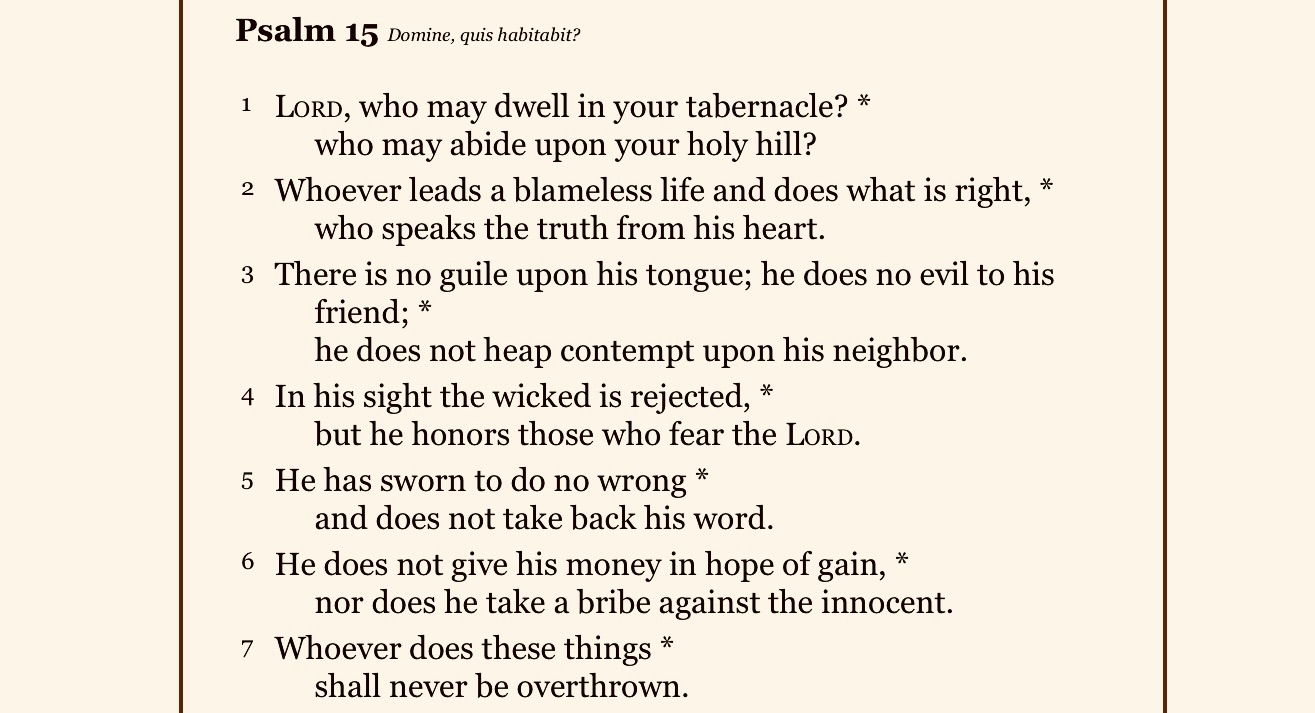
Psalm 15, Domine, quis habitabit?
1 Lord, who may dwell in your tabernacle? *
who may abide upon your holy hill?
2 Whoever leads a blameless life and does what is right, *
who speaks the truth from his heart.
3 There is no guile upon his tongue; he does no evil to his friend; *
he does not heap contempt upon his neighbor.
4 In his sight the wicked is rejected, *
but he honors those who fear the Lord.
5 He has sworn to do no wrong *
and does not take back his word.
6 He does not give his money in hope of gain, *
nor does he take a bribe against the innocent.
7 Whoever does these things *
shall never be overthrown.
The psalmist, sitting and composing in the presence of God, asks a metaquestion, a question about the situation in which he is asking the question: under what conditions is a person able to sit, or stand, in the tabernacle—in the presence of God?
The insight that comes immediately: the condition is blamelessness. Moral uprightness. Doing what is right.
Blamelessness is not an abstract or theoretical concept. It is a name that signifies, it points to specific behaviors.
Verse 2: It means telling the truth. Not just occasionally. Not instrumentally, when it serves some other purpose, but naturally, “from the heart.” The truthful words spoken through the mouth originate in a heart that dwells in truth, is committed to truth. A person with that kind of heart is a person who dwells in the presence of God, in the tabernacle.
Verse 3: It means treating other people straightforwardly and well. Not with guile: not strategizing about how to gain advantage over them, how to use them for one’s own pleasure or profit. Not treating other people with contempt, certainly not “heaping contempt” on them. Sitting in the presence of God, the psalmist is troubled by the awareness of people who do not just occasionally speak ill of one other person but who do it in spades, in heaps, against other people in general. When asking what kind of person can abide in the presence of God, the psalmist thinks of the contempt-heaper as the first negative example.
Verse 4: Next item: who you associate with. Isn’t this striking? The two prior qualifications have to do with the moral constitution of the individual. One positive—commitment to truth. One negative: not contemptuous of other people. But this third condition is social: it’s not about what you do yourself, it’s about the clarity of your moral discernment regarding others. If you want to dwell in the presence of God, you must be a person who sees and rejects wickedness in other people, and who sees and honors godliness in other people.
This third qualification is a direct application of the first qualification, truthfulness. Being truthful is incompatible with seeing wickedness in others and calling it righteousness, or approving it, or even passively accepting it. If you do not reject wicked people, you cannot sit in the presence of God. If you do not honor people who are godly, you cannot sit in the presence of God. Because the presence of God is not a phone booth, a place that fits only one person, only you. It is a tabernacle: a big tent, with other people in it. If you are unable to see wickedness in others and reject it, and to see godliness in others and honor it, you are going to end up hanging out with the wrong crowd, in the wrong tent, in the presence of the wrong god.
Verse 5: The person who may enter and abide in the tabernacle of the true God is one who does not just do right casually but is committed—sworn!—to doing no wrong. Truthful speech may simply flow from a truthful heart, but avoiding unrighteous action requires deliberate resolution and a spoken-out-loud commitment. The dweller-with-God must be one who has made a definite, verbal commitment to not doing wrong, and who has not revoked that commitment, has not contradicted it by word or deed. This, I think, is an acknowledgment that even for those who would like to dwell in God’s presence, who have a truthful disposition, and who are not in the habit of heaping contempt on other people, it is nevertheless hard to avoid slipping into wrongdoing. This is why one must swear it off.
Pause: take stock now. You are the psalmist, sitting in the presence of God, meditating on the conditions of abiding in the presence of God. You are going to write the perfect number of verses: seven statements. You have used five of your slots, and you are going to need one for a conclusion, so you have one more slot to fill. What will it be?
Verse 6, answer: Corruption enabled by money is a disqualifier. You can’t be in God’s tabernacle, in God’s presence, if you are a grifter. If you use the money that you have to get more money, you’re out. If you accept money from others as an incentive for doing things that harm people whom you should not harm, you’re out. Money is an instrument for supporting your own life and the life of others. It is not an instrument for accumulating more money, not an end in itself. Those who are not clear on that point are not, cannot be, dwellers in the presence of God. Those who are so far from understanding this that they actually accept money as an inducement to take actions that harm innocent people are utterly beyond the pale.
Verse 7 is this conclusion: those who meet these qualification will never be overthrown. Implication: those who fail these qualifications—and who therefore cannot abide in the presence of God—are likely to be overthrown.
===========
I cannot read these psalms in a vacuum.
It’s no good trying to read this stuff as an exercise in individual piety. Right smack dab in the middle, this psalm tells us: it is centrally about who you approve of, who you are willing to tolerate and associate with.
That is to say, in our moment: this psalm tells us, in a few short verses, how American evangelicalism, in giving in to the Trump delusion—in accepting as its hero and champion the lying, contempt-slinging, money-worshiping and bribe-chasing Donald Trump—exited the tabernacle of the living God and became a synagogue of Satan.
 Verba Sparsa