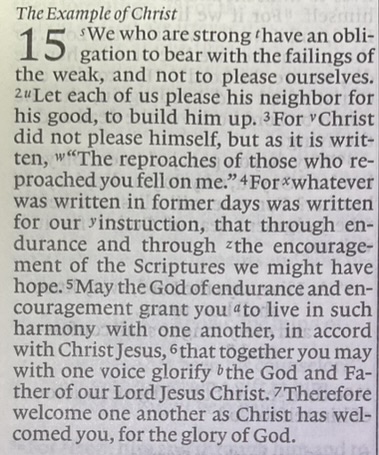
The apostle urges: “We who are strong have an obligation to bear with the failings of the weak, and not to please ourselves” (Romans 15:1). But we may reply: Who are the strong? And who are the weak?
This problem is reminiscent of the “Who is my neighbor?” problem in Luke 10. There, when the young lawyer is told that he must love his neighbor as himself, he asks a question designed to limit that obligation. In reply, Jesus tells him a story, the point of which (there’s more to it than this, but it says at least this): YOU are the one who is being commanded to love, and the person whom you must love is anyone you see in need, whether or not that person is in your social and religious in-group. Your obligation to love, Jesus tells him, is unlimited.
Maybe here in Romans 15, if you are the person who hears Paul talking to you, then you are the recipient of the command to bear with the failings of the weak, and “the weak” are the people whom you perceive as having failings that you might or might not want to bear with. Because you see yourself as “strong,” don’t you? Doesn’t everybody?
Actually, no. Here is one of the biggest facepalms I know of in the history of the reception of the Bible: in my lifetime I have known people who claim the label “weaker” for themselves in order to use their cultivated and coddled “weaker brother/sister” status as a lever for getting their way. They threaten to be offended—scandalized, even!—if you drink that glass of wine, or wear your hair too long, or . . . whatever. Therefore you must not do it, or they will be shocked and scandalized, and maybe Jesus will hang a millstone around your neck and throw you into the sea. —Now, that’s remarkable biblical interpretation and strange discipleship.
Paul is clear about who is strong and who is weak among the Roman believers. He is responding in Romans 14 and 15 to disagreements in communities of Jesus-followers at Rome that included both Jews and gentiles as to whether all Jesus-followers had to observe traditional—and biblical!—Jewish practices with regard to diet and calendar: things you can’t eat, and days you must treat as special holy days.
If you recall the account in Acts 15 of the settlement reached at Jerusalem in matters of this sort: the apostles make the remarkable concession that for gentile converts, circumcision—one of the most essential boundary markers in the history of the Hebrew people of God, a clear command of scripture and an inviolable tradition—is dispensable. However, they said, we must draw certain lines, and here they are: (1) abstain from the things ritually defiled by idols, and (2) from porneia (an ill-defined term related to sexual immorality), and (3) from what has been strangled, and (4) from blood. Note that three of these things have to do with dietary practices: eating food that has been sacrificed to idols (which would be true of much of the food available in markets in a Greco-Roman city), and eating animals that have not been slaughtered and cooked in ways that produce bloodless meat.
But Paul, in Romans 14 and 1 Corinthians 8, in a move that is almost as remarkable as the Jerusalem Council’s brushing aside of circumcision, brushes aside that council’s dietary strictures. For Paul, those who worry about whether food has been sacrificed to idols are “weak”! The “strong” realize that these matters are inconsequential and cannot be set up as limits on God’s plan for welcoming all peoples and nations into the fellowship of Jesus.
Notably, Paul does not brush aside the stricture against πορνεία—sexual immorality. For example, in 1 Corinthians 5, he flatly orders the Corinthians community to expel a man who—ahem—“has” his father’s wife. He does not resort to scripture to condemn that case of incest! He only says that even the ἔθνοι (gentiles) would not tolerate such an outrage.
And in Romans 1, a high-flying rhetorical performance in which he cites what he is quite sure everyone will agree represents the lowest pit of blatant gentile depravity, he references men resorting to sex with men, and women with women. So I think it’s quite plain—all the tortured revisionist explanations to the contrary notwithstanding—that it never entered Paul’s imagination that same-sex practice (or same-sex attraction) could be anything other than immoral, anything other than symptomatic of ingratitude toward God, worship of creature over creator, and hence emblematic of the unacceptability of gentiles and their impurities. In Paul’s masterful oration, this is a set-up for his conclusion some paragraphs later that Jews and gentiles are in the same boat, and that gentiles can be accepted. But he did not imagine that they could come as they are, including the same-sex-attracted among them, because he takes it for granted that innate attractions are always heterosexual, and that nature itself condemns homosexual attraction and practice. He doesn’t cite Genesis or Leviticus! He says only that it is contrary to the “natural use,” the φυσικὴ χρῆσις, so that even the gentiles should have known.
Where else does he use this “obviously contrary to nature” argument? The only place I can think of is 1 Corinthians 11, where he says—fully confident that no one could possibly disagree, it is so obvious!—that nature itself (ἡ φύσις αὐτή) teaches that if a man has long hair it is a “dishonor” (ἀτιμία). Not a divine command, not from scripture, not even a theological argument grounded in scripture: “nature itself teaches.” What are we to do with that? For me personally, it’s not a live question. My hair is sparse and could not be grown long anyway. But what if I could grow long hair? Should I see in 1 Corinthians 11, which claims no divine command (and cannot, because scripture includes stories of men whose uncut hair was indicative of their extraordinary faithfulness to God!), a divine command not to grow my hair long? Different Christian men reach different conclusions on that question.
Some people think that human understanding of nature has advanced on several topics in the last two millennia. And some think that any understanding of nature that conflicts with any assumption shared by biblical writers and their contemporaries is to be rejected.
Our churches today are splitting apart because some believers assume that what Paul and the other first-century and second-century Jesus-followers were able to realize, with great difficulty, about the wideness of God’s mercy represents the widest possible extent of that mercy. It widened at Jerusalem, and widened further as the apostles took the gospel into the gentile world, but that’s it. No further. While others want to discern a trajectory, a pattern of the Spirit leading God’s people into truth over time, discernible within scripture—from Law, to Prophets, to Writings, then onward, not with utter novelty but certainly with unforeseen expansiveness, in new writings of the New Covenant. And they want to allow (taking a cue from what Jesus says in John 16) that this trajectory can continue beyond scripture.
The churches in our modern era have struggled over expanded understandings of the morality of slavery, of the subordination of women, of divorce and remarriage, and other ethical topics. Some churches are embarrassed by the distance between the New Testament writers’ acceptance of slavery and current condemnations of slavery and don’t want to talk about it. Some still actively promote the subordination of women, believing that faithfulness to scripture requires it. The local church in which I was raised participated in a dividing (the Greek-derived word for this is “schism”) of the body of Christ to join with others in founding a new denomination that would perpetuate their inability, or unwillingness, to see God use women in leadership in the churches. Divorced and remarried men can be elders. But women cannot.
And now the churches—on the level of local congregations and denominations—are dividing over disagreement about whether God welcomes people with different gender identities and sexual orientations. Christian groups that still think it’s right to subordinate some ethnicities to others, or to subordinate women to men, will not struggle over this new question. It’s not even a question for them. But even believers and bodies of believers who have accepted ethnic equality and gender equality cannot automatically also accept diversity in sexual identity and practice. It’s not that easy. It’s a harder question.
But—here’s the rub—is it really a different kind of question? Or is it just another instance in the succession of questions, from circumcision to meat sacrificed to idols and downward through the ages to modernity, that are all about the triumphal advance of the all-embracing mercy of the God who is love?
On that point we have disagreements. And do you think that the idea of accepting gay believers as brothers and sisters in Christ without requiring them to deny their sexual orientation and abandon their faithful partnerships is more shocking and offensive to contemporary American Christians than was the idea of welcoming gentiles as brothers and sisters in Christ while they remained uncircumcised and kept eating food that had contaminating associations with pagan idol-worship to Jewish Jesus-followers at Rome the middle of the first century?
And—back to Romans 15—is this a matter of “strong” and “weak”? If no, why not? If so—which are you? Are you strong or weak? And if you are strong, then what does it mean for you that Paul says that the “strong have an obligation (Ὀφείλομεν) to bear with the failings of the weak”? He does not say that nature teaches us this obligation! No. In this case, he says, we are dealing with the question of whether or not we are willing to follow the example of Christ. “Therefore welcome one another as Christ has welcomed you, for the glory of God.”
What do I think about the gay-inclusion question? Not sure why my opinion should matter to you. I will tell you this, though. The older I get, the less patience I have for the assumption that in any disagreement, whoever claims to be the most shocked, offended, or affronted wins. And the less patience I have for this-verse-against-that-verse amateur-Bible-lawyer battles in which MY side (whether that’s the socially regressive or conservative side, or the progressive, libertine, or iconoclastic side—the latter being less common among folks who think that comparing the literal sense of various Bible verses is the way to decide anything) always has to win. I oppose accommodation to the world, the flesh, and the devil. I see all three in refusals by any Christian to follow Christ in welcoming the weak and bearing with their failings. I see all three whenever anyone insists on the invincible, exclusive righteousness of their own understanding of moral and doctrinal strongness, regardless of the division, distress, and pain caused to other people for whom Christ died. I am suspicious of everyone’s reasoning—everyone’s—in theological and ethical discussions pertaining to sex. And I am suspicious of every assumption that whatever is pleasing to me (or to you) is pleasing to God—especially if what is pleasing to me (or to you) is the exclusion of entire classes of people from Christ’s welcome.
“Therefore welcome one another as Christ has welcomed you, for the glory of God. . . . We who are strong have an obligation to bear with the failings of the weak, and not to please ourselves.”
 Verba Sparsa